A Beginner's Guide to Norfolk's Medieval Churches: How to Spot Norman and Gothic Features
Drive anywhere in Norfolk and you will pass one: a squat flint tower above a hedge, or a tall one with battlements and a bell. Hundreds of medieval churches survive in the county, most of them still in regular use. The trouble is that they can blur together into a pleasant grey haze until you know what you are looking at. Once you can date a doorway or a window at a glance, a routine drive to the coast turns into a treasure hunt.
The good news is that you do not need a degree in architectural history. A few basic rules will let you tell Norman from Gothic, and a handful of details will help you guess the century. This guide is for the curious beginner: the driver who pulls over at a church gate, the walker following a footpath past a tower, the visitor who wants to know why one church feels heavy and another seems to float.
Why Norfolk's churches look the way they do
Norfolk has almost no good building stone of its own. What it has is flint, turned up by the plough and dug from gravel pits, and the medieval answer was to build walls of flint rubble and spend money only on the parts that had to take a sharp edge: corners, doorways, window surrounds. That is why so many churches here look pebbly and grey, with crisp pale limestone dressings, much of it shipped across from Caen in Normandy in the centuries after the Conquest.
Flint also explains the round towers. A square corner built from rounded rubble is awkward to get right and hard to keep weathertight, while a round tower has no corners at all. Norfolk has more round-tower churches than any other county, well over a hundred of them, scattered from the Broads to the Brecks.
But flint is only half the story. Norfolk was rich in the Middle Ages. Wool, cloth, trade and agriculture paid for a great wave of church building and rebuilding, especially in the fourteenth and fifteenth centuries. The result is that many churches are palimpsests: a Norman nave, a thirteenth-century chancel, a fifteenth-century tower and porch, all stitched together. You are not looking at one date. You are reading layers.
The two broad styles: Norman and Gothic
Medieval church architecture in England is usually divided into two great periods, with a transitional phase in between. Norman (also called Romanesque) runs from about 1066 to 1200. Gothic runs from about 1200 to the Reformation in the sixteenth century. The simplest clue is the arch.
- Norman: round arches, thick walls, small windows, deep doorways, heavy proportions.
- Early English Gothic: pointed arches, slender lancet windows, simpler tracery, often tall and spare.
- Decorated Gothic: flowing, curving tracery, richer carving, ogee arches, more ornament.
- Perpendicular Gothic: strong vertical lines, huge windows, flat roofs, fan vaults, battlements, pinnacles and towers.
Norfolk is especially rich in Perpendicular work. The wool churches of the north Norfolk coast and the west Norfolk marshland often have soaring towers, flushwork battlements and interiors flooded with light through vast traceried windows. If a church looks proud, vertical and slightly showy, you are probably looking at the fifteenth century.
Spotting Norman features
Start at the doorway. Norman doorways are usually round-headed and deeply recessed. They often have several orders of arches, each supported by small columns with carved capitals. Look for scalloped capitals, cushion capitals, zigzag or chevron ornament, and sometimes beakheads or grotesque faces. The doorway may be the oldest part of the church, reused when the rest was rebuilt.
Next, look at the windows. Norman windows are small and round-headed, often set high in the wall. They let in less light, because the technology of the time favoured thick walls and small openings. In some churches you can see these early windows blocked or partly hidden behind later work. Norman towers often have round-headed openings for bells, sometimes arranged in pairs.
Inside, the Norman signature is the heavy round arch between nave and chancel, or between nave and aisle. Norman fonts are often square, tub-shaped and carved with arcading or chevron. Burnham Deepdale has a famous Norman font carved with the months of the year, a wonderful example of how much detail can survive in a small village church. For grander Norman work, visit Norwich Cathedral or the ruins of Castle Acre Priory, both of which show the style at scale.
Look first at the doorway, then at the windows, then at the tower. The rest of the story will follow.
Spotting Gothic features
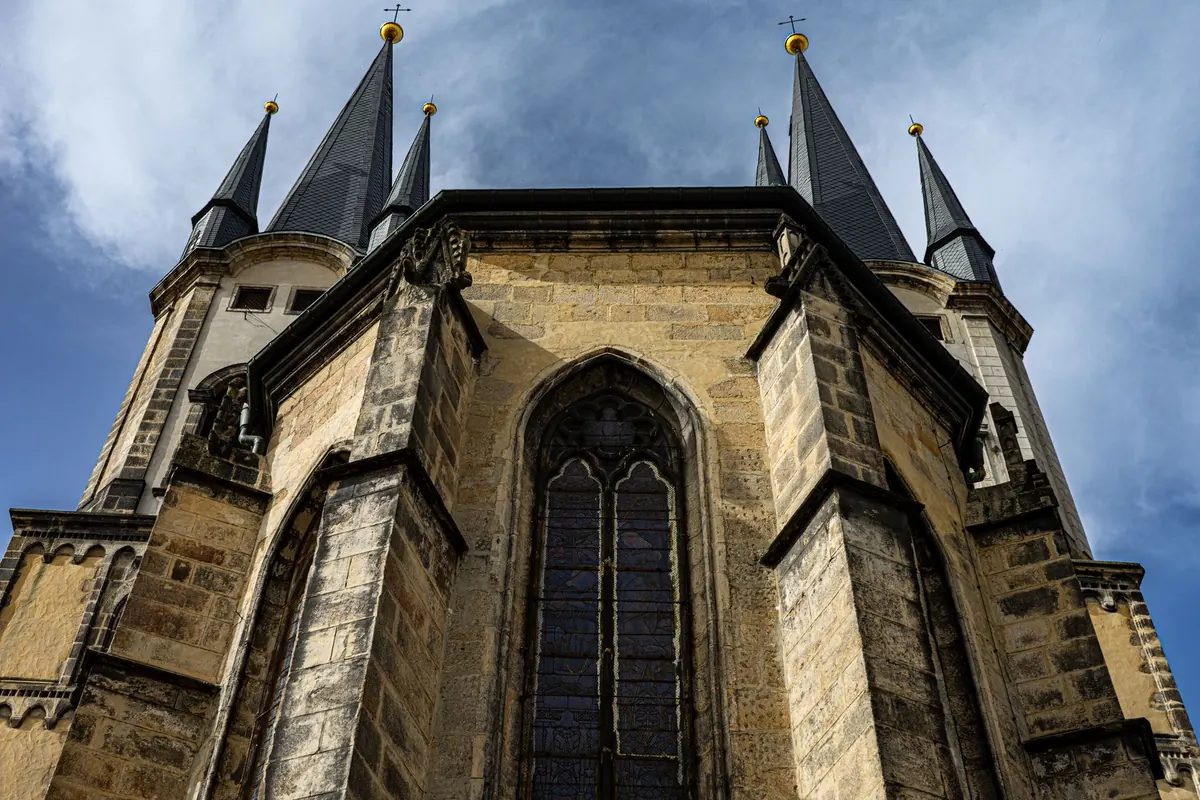
The pointed arch is the great giveaway. Once builders mastered the pointed arch and the flying buttress, walls could be thinner, windows could be larger, and interiors could be filled with coloured glass. In a Norfolk parish church, Gothic often appears as a tall west tower, a wide east window, a battlemented porch and a nave lit by rows of pointed windows.
Look at the tracery: the stone ribs inside the window opening. Early English tracery is simple, often just a pointed lancet or a circle above two lancets. Decorated tracery flows and curves like branches. Perpendicular tracery is dominated by vertical mullions running from bottom to top, with horizontal transoms, creating a grid of stone and glass. Norfolk's Perpendicular churches often have flushwork: patterns made from knapped flint and limestone, especially on towers and porches. Salle, Cley, Blakeney, Walpole St Peter and Terrington St Clement are all rewarding places to see this late medieval confidence.
Outside, look for buttresses. Norman walls tend to be thick enough to stand on their own. Gothic walls are often supported by stepped buttresses, which push against the wall and allow taller, thinner structures. Battlements, pinnacles, gargoyles and carved label stops are also Gothic favourites. Inside, look for slender piers, carved capitals with leaves, and roofs with hammerbeams, angels and carved bosses.
How to date a window at a glance
- Round arch, small opening: Norman, roughly 1066–1200.
- Pointed lancet, little or no tracery: Early English, roughly 1200–1300.
- Pointed window with flowing, curving tracery: Decorated, roughly 1300–1350.
- Pointed window with strong vertical mullions and horizontal transoms: Perpendicular, roughly 1350–1540.
- Rectangular window with classical mouldings: later, often Georgian or Victorian.
This is a rule of thumb, not a law. Churches were repaired, enlarged, restored and reordered. A Norman doorway may sit beneath a Perpendicular tower. A Gothic window may be a Victorian copy. The fun is in noticing the joins.
Inside the church: fonts, screens and roofs
Outside tells you the date; inside tells you the wealth and the devotion. Fonts are often the oldest surviving fitting. Norman fonts are tub-shaped and carved. Later fonts are octagonal, with panels showing saints, angels or the seven sacraments. Rood screens, which separated the nave from the chancel, were once painted with saints and prophets. Many were destroyed or whitewashed at the Reformation, but Norfolk retains a remarkable number. Ranworth and Barton Turf are famous for their painted screens.
Look up. Norfolk's late medieval churches often have magnificent timber roofs. Hammerbeam roofs, angel roofs and carved bosses are common in the richer churches. Look down. Ledger stones, brasses and floor tiles can give you names and dates. Look at the walls. Medieval wall paintings sometimes survive under later plaster, as at Houghton-on-the-Hill. Even a small village church can hold a surprising amount.
Why so many round towers?
The round tower is one of Norfolk's signature features. There are more than one hundred of them in the county, and they are concentrated in the east and north. The usual explanation is practical: flint rubble makes a poor square corner, and a round tower avoids corners altogether. Many round towers are earlier than the rest of the church, with a later Gothic nave or chancel attached. Some have been heightened with octagonal belfries in the later Middle Ages. If you see a round tower with a pointed arch window or a battlemented top, you are looking at layers of building in one structure.
A short church-crawl itinerary for beginners
If you want to test your new skills, try a route that gives you a range of styles in a single day.
- Norwich Cathedral: start with the Norman nave and cloisters, then notice later Gothic additions.
- Castle Acre Priory: Norman grandeur in ruins, with a remarkable prior's house and gatehouse.
- Burnham Deepdale: a small church with a famous Norman font carved with the labours of the months.
- Salle: a soaring Perpendicular church, often called the cathedral of the Broads.
- Cley and Blakeney: two coastal churches with tall towers, flushwork and a strong sense of late medieval prosperity.
- Walpole St Peter and Terrington St Clement: west Norfolk marshland churches with magnificent interiors and roofs.
You do not need to visit all of them in one go. Pick two or three, take your time, and compare what you see.
Practical tips for a church visit
- Check opening times before you travel. Many churches are open daily, but some are locked except for services.
- Look for guidebooks, leaflets and donation boxes. They often explain the building's history and help with upkeep.
- Be respectful. If a service or private event is happening, come back later. Do not touch wall paintings, brasses or fragile stone.
- Take binoculars for roof bosses, tracery and high windows. A small torch can help in dark corners, but avoid flash photography.
- Visit in the morning or late afternoon when low light rakes across flint and carving.
- Use the Norfolk Churches Trust and Churches Conservation Trust websites to find interesting buildings and open days.
Common mistakes to avoid
Do not assume that everything you see is medieval. The Victorians restored hundreds of churches, replacing roofs, windows, pews and sometimes entire walls. A crisp, sharp-edged window may be nineteenth-century. A round arch may be Norman, but it may also be a Victorian revival. Look for weathering, tool marks and changes in stone. Do not confuse a round tower with a round apse; the apse is at the east end, the tower usually at the west. And do not think that a small church is unimportant. Some of the best details—a carved font, a painted screen, a roof boss—are in the quietest places.
Final thoughts
Norfolk's medieval churches are not a museum. They are working buildings, shaped by centuries of worship, neglect, repair and affection. Learning to spot Norman and Gothic features does not spoil the mystery; it deepens it. The next time you pass a flint tower above a hedge, pull over. Look at the doorway. Check the windows. Look up at the roof. You will find that the grey haze has turned into a story, and the story is written in flint, limestone, timber and glass.
Photo: Jiří Dočkal / Pexels